Understand the difference between protecting a network and keeping every application available.
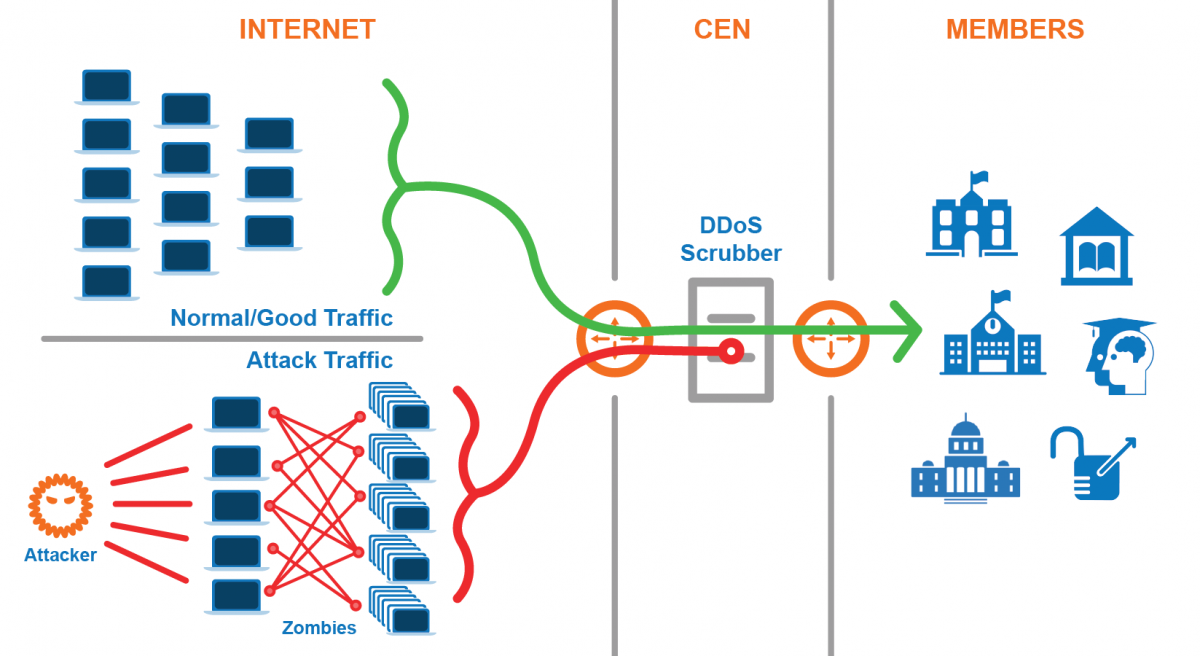
Traffic filtering illustrated by Connecticut Education Network. This diagram explains the concept; it is not a map of HexaCraft’s network.
A distributed denial-of-service attack sends unwanted traffic from many sources to overwhelm a connection or service. Filtering aims to separate legitimate traffic from attack traffic before it consumes the resources your players need.
How traffic reaches your server
Incoming traffic
Players and other clients connect to the service’s public address.
Detection and filtering
Network systems inspect traffic patterns and apply the configured mitigation rules.
Allowed traffic
Traffic permitted by those rules continues towards the server. Some attacks can still affect connectivity.
Standard and Premium: what the terms mean
These are general protection categories, not universal specifications. HexaCraft’s exact plan assignments, providers and limits are awaiting confirmation. Ask support for the protection included with your chosen plan and location before ordering.
STANDARD
Network-level mitigation
Typically focuses on common network and transport-layer attacks, such as packet floods or excessive connection attempts. Upstream filtering, rate limits and routing policies help protect the surrounding network.
If an attack exceeds available filtering or affects the wider network, a provider may temporarily blackhole the targeted address. This blocks legitimate traffic too; it is not uninterrupted service.
PREMIUM
More specialised filtering
May add more filtering capacity, workload-specific rules or different protected routes. What changes must be specified for the actual product; the word “Premium” alone does not establish capacity or application-level coverage.
Ask about supported protocols, game-specific filtering, escalation and incident handling. Advanced protection can reduce risk but cannot promise zero downtime or immunity to every attack.
Network protection is not the same as application protection
Network-layer mitigation addresses traffic aimed at connections and network capacity. Application attacks can look like valid requests, such as repeated logins or expensive game actions. A Minecraft server may also need compatible plugins, sensible connection limits and secure configuration.
Cloudflare describes Magic Transit as network DDoS protection. Do not assume that a network-protected server automatically includes a website WAF, game-protocol proxy or every application-layer rule.
Ask these questions before choosing protection
Which tier and provider cover my exact location and IP?
Which TCP/UDP ports and application protocols are covered?
Can filtering or null-routing interrupt my service, and how is recovery handled?
What is included in the price, and are any limits or add-ons applicable?
How do I report an attack and receive incident updates?
No mitigation capacity, fixed recovery time or plan-specific Premium entitlement is claimed on this page until confirmed.